
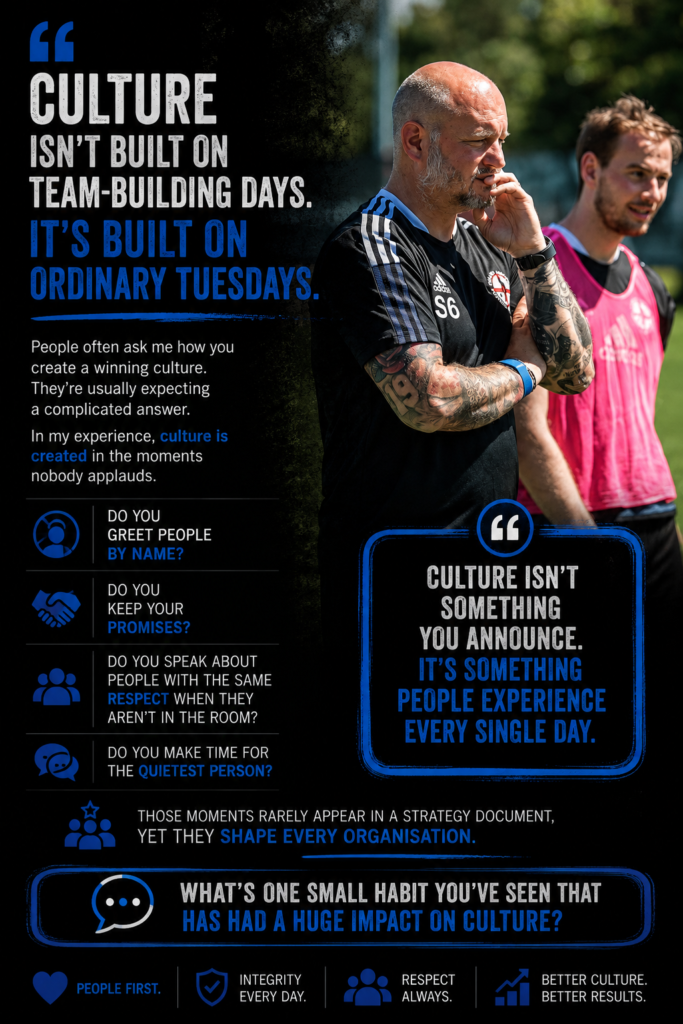
People often ask me how you create a winning culture. They're usually expecting a complicated answer. A framework. A model. A slide with arrows on it.
In my experience, culture is created in the moments nobody applauds.
It isn't the away day, the paintballing or the new set of values on the wall. Those things can be fun, and they can help. But they don't build culture. Ordinary Tuesdays do.
The questions that actually matter
After twenty years in classrooms and dressing rooms, from St Helens to the international stage with England, these are the questions I keep coming back to:
- Do you greet people by name? It sounds small. It isn't. It tells someone they've been noticed.
- Do you keep your promises? Even the little ones. Especially the little ones. Trust is built in tiny deposits.
- Do you speak about people with the same respect when they aren't in the room? Everybody notices how you talk about the person who has just left.
- Do you make time for the quietest person? The loudest voices get heard anyway. Leaders go looking for the others.
Why the small things are the big things
Those moments rarely appear in a strategy document. Yet they shape every organisation I've ever been part of.
With the England Amputee squad, the culture wasn't made in the big speeches before tournaments. It was made in how we spoke to each other at a wet training camp, how we treated the kit staff, and how we picked someone up after a bad session. By the time we got to a final, the culture was already decided.
The same is true in a school, an office or a boardroom. If you want to know what your culture really is, don't read the values statement. Watch what happens on an ordinary Tuesday afternoon.
People first. Integrity every day. Respect always. Better culture leads to better results.
What's one small habit you've seen that has had a huge impact on culture?
Scott Rogers BEM. Leadership, Culture, Impact.
← More leadership lessons